
Skin Cycling for Acne: The 4-Night Routine That Works
If your acne keeps getting worse the harder you fight it, skin cycling for acne might be the fix you’ve been missing. Just ask Maya. She had thirty-one products on her bathroom shelf. She counted them once, at 1 a.m., because she couldn’t sleep. Toners. Serums. Three different exfoliants. A spot treatment for the spots. Another spot treatment for when that one failed.
Table of Contents
When Your Acne Routine Has Too Many Products

She used to have clear skin. That was the cruel part. At sixteen, she barely washed her face and glowed anyway. Then adult acne arrived at twenty-four like an uninvited roommate. It moved into her chin. It spread to her jaw. It settled in and refused to leave.
She wasn’t alone in it, either. A study published in the Journal of the American Academy of Dermatology found that about half of women in their twenties still deal with acne — so adult acne is far more common than the “teenage problem” myth makes it sound. And the real causes of adult acne are usually hormonal, not a hygiene failure — which is exactly why scrubbing harder tends to backfire.
So Maya declared war.
Why “More Products” Feels Like the Right Fix for Acne
Here’s the thing nobody warned her about. The war made sense. Acne is bad. Products fight acne. So more products should fight harder, right? That was the math in her head.
She thought of her face like a dirty kitchen. Scrub harder. Use stronger stuff. Attack the mess until it’s gone.
- Salicylic acid cleanser every morning
- Glycolic acid toner every night
- Retinol on top of that
- Benzoyl peroxide spot treatment
- A scrub twice a week “just to really get in there”
She layered them like armor. She had no idea that benzoyl peroxide and salicylic acid do very different jobs and were never meant to be piled on top of each other — or that a routine for breakouts is supposed to start with a few well-chosen basics, not thirty-one of them. Some nights her face tingled. Some nights it stung. She told herself the sting meant it was working. Pain was progress. That’s what her brain decided.
Is Your Skin Purging or Just Getting Worse?
Her skin got worse. But Maya had a word ready for that. Skin purging.
She’d read it online. The idea is simple. When you start strong actives, your skin pushes everything out at once. It looks worse first, then better.
So every new breakout became “proof.” Proof the products were working. Proof she just needed to push through.
Her cheeks turned red and tight. Little flakes peeled around her nose. She’d never had dry skin in her life, and now it cracked.
“Purging,” she whispered, and slathered on more.
Three months passed. Then four. The “better” part never came.
When Makeup Won’t Cover Acne Breakouts
Then came Priya’s wedding. Maya loved Priya. She’d known her since college. She wanted to look nice, just once, for one good day.
She spent an hour on makeup. She layered concealer over the bumps. She powdered. She prayed.
The photos came back a week later. Maya scrolled through them alone on her couch. In every single one, her skin looked angry. The concealer had caught on the flakes. The bumps showed through like little hills under snow.
She zoomed in on her own jaw. Red. Raw. Broken.
She put the phone face-down on the cushion. She didn’t cry, exactly. She just felt tired in a way that went all the way down.
Maybe Your Skin Isn’t Broken — It’s Exhausted
Her sister called that night. Maya mentioned the photos, trying to laugh it off.
“Have you thought about maybe doing less?” her sister asked.
Maya bristled. Less? She was doing everything right. She had the routine. She had the science. She had thirty-one products.
“You don’t get it,” Maya said. “My skin is just broken. It’s genetic or hormonal or something. Nothing works on me.”
Her sister was quiet for a second. “Or,” she said gently, “maybe your skin isn’t broken. Maybe it’s exhausted.”
Maya hung up kind of annoyed. But the word stuck to her like a burr. Exhausted.
What Happens When You Do Less for Acne
She couldn’t shake it. So a few days later, she did something that scared her. She stopped.
Not everything. But she put away the scrub. She put away the toner. She put away two of the three exfoliants.
That first night, she washed her face with a plain gentle cleanser. Just water and a mild soap, basically. Then a simple moisturizer. Nothing else.
Her hands felt empty. Her brain screamed that she was letting the acne win. That she was being lazy. That she’d wake up covered in new bumps.
She barely slept. She was sure she’d sabotaged herself.
Why Doing Less Calmed Her Irritated Skin
She woke up. She walked to the mirror bracing for disaster.
Her skin wasn’t clear. Let’s be honest. Acne doesn’t vanish overnight. But something small had shifted. The redness had calmed a shade. The tight, cracked feeling around her nose had softened. Her face didn’t sting when she touched it.
For the first time in months, it didn’t hurt to smile.
She stood there confused. She’d done less. And less had helped. It made no sense to the part of her brain still stuck in war mode.
Acne vs. Irritation: How to Tell the Difference
That weekend, Maya finally booked a real appointment. Not a TikTok video. An actual board-certified dermatologist.
She braced for a lecture. Instead, the doctor looked at her skin under a light and asked one question.
“How many active ingredients are you using?”
Maya listed them. The doctor’s eyebrows went up slowly with each one.
“Your acne is real,” she said. “But a lot of what I’m seeing right now isn’t acne. It’s irritation. You’ve been stripping your skin barrier.”
Maya didn’t know what a skin barrier even was.
How Over-Exfoliating Damages Your Skin Barrier
The doctor explained it simply, like this. Your skin has a top layer. Think of it as a brick wall. The bricks are skin cells. The glue between them is oil and fat that holds water in. That wall keeps the good stuff in and the bad stuff out. It’s your protection.
- Strong acids strip that glue
- Retinol on top strips more
- Scrubbing knocks the bricks loose
- Do it every single day, and the wall never gets rebuilt
“You’ve been over-exfoliating — tearing down your wall every night,” the doctor said. “So your skin stays inflamed. Inflamed skin breaks out more. It’s a loop.”
Maya felt her face go hot. Not from irritation this time. From recognition. She’d been attacking the very thing that was supposed to protect her.
The Skin Cycling Routine for Acne, Explained
Then the doctor told her the fix. And honestly, Maya almost laughed, because it sounded too simple to work. Instead of using everything every night, she’d spread her actives across four nights — a method a board-certified dermatologist named Dr. Whitney Bowe made famous as “skin cycling.”
So what is skin cycling for acne, exactly?
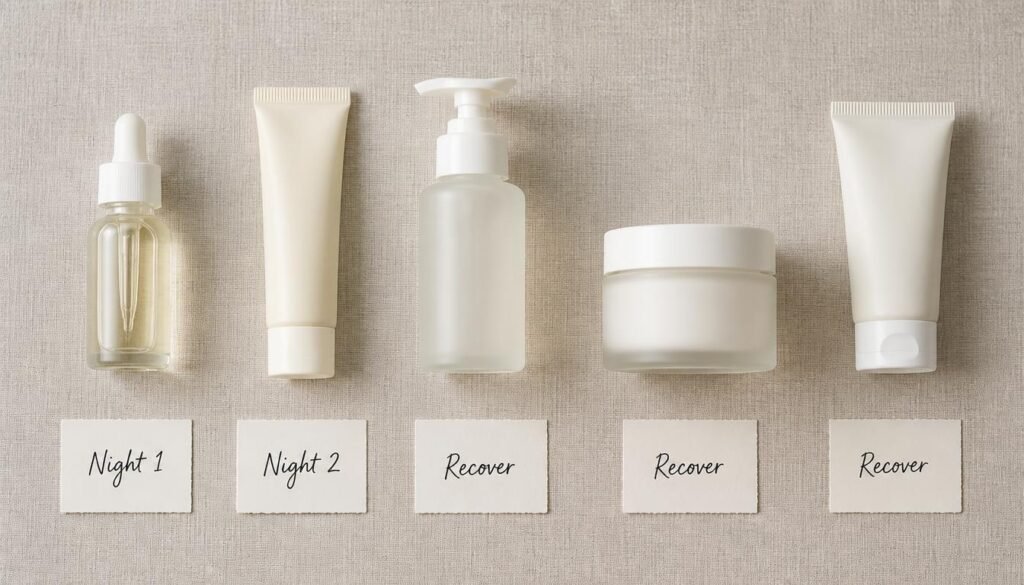
Skin cycling for acne is a four-night skincare routine that rotates active ingredients with recovery nights so your skin barrier can heal:
- Night one: exfoliate with one gentle acid.
- Night two: apply a retinoid.
- Night three: recover with cleanser and moisturizer.
- Night four: recover again, then repeat.
The doctor drew it out on a little pad. Night one, exfoliate with one gentle acid — that’s it. Night two, a retinoid — one of the treatments dermatologists most strongly recommend for acne — the ingredient that fights breakouts and unclogs pores. Nights three and four, recovery: just cleanser and moisturizer while the barrier rebuilds. Then loop back to night one and start over.
“The actives still do their job,” the doctor said. “But now your skin gets to heal in between. Strong stuff works better on healthy skin than on wounded skin.”
One honest caveat: skin cycling isn’t a cure for every kind of acne. If yours is severe, cystic, or painful, it’s worth knowing when to see a dermatologist for acne so the rhythm can be paired with a prescription. But for skin that’s been over-treated into irritation, the reset is often exactly what’s been missing.
Watch: The Dermatologist Who Created Skin Cycling Explains It Step by Step
Dr. Whitney Bowe — the board-certified dermatologist who coined skin cycling — breaks down the exact four-night routine, step by step:
Video: Dermatologist Who Introduced Viral Trend Skin Cycling on TikTok Explains How to Do It
Why Skin Cycling Recovery Nights Matter
Maya went home and tried it. And the weirdest challenge wasn’t the acid or the retinoid. It was the recovery nights.
Standing at the sink with clean skin and not putting an active on it felt wrong. Her hand kept reaching for a bottle. Her brain kept saying you’re not doing enough.
But she held the line. Cleanser. Moisturizer. Bed. Two nights of rest. Then the actives again. Then rest.
A steady rhythm instead of a daily assault. She stopped treating her face like a battlefield. She started treating it like something that could heal.
Skin Cycling for Acne: What to Expect Week by Week

Change came slowly, the way real change does.
Week two, the flakes were gone. Week three, the redness faded to almost nothing. Her skin felt calm. Bendy. Alive.
Week six, she noticed it in a store window. She caught her reflection and didn’t flinch. The deep bumps along her jaw had shrunk. New ones barely showed up. When one did, it healed in days instead of weeks.
Her skin wasn’t perfect. She’ll tell you that straight. But it was hers again. Soft and whole and no longer at war.
She thought about her sister on the phone. Maybe it’s not broken. Maybe it’s exhausted. Her sister had been right.
Paring Down to a Simple Acne Routine
Maya cleaned out her bathroom shelf on a Sunday. Thirty-one products became six. A gentle cleanser. An exfoliant. A retinoid. A moisturizer. Sunscreen. One backup.
She threw the rest in a box. All that money. All that scrubbing. All that pain, chasing the idea that more was the answer. What she landed on instead was basically a simple acne routine: cleanser, treatment, moisturizer, sunscreen — and nothing fighting for space.
She’d been so sure her skin was the problem. Turns out the routine was the problem. She’d been drowning her skin and calling it care.
The bumps hadn’t needed a harder fight. They’d needed a smarter rhythm. They’d needed room to breathe.
Why Skin Cycling for Acne Actually Works
Here’s the part that stings. The harder you fight your acne, the more you feed it. Every extra acid, every nightly scrub, every “just to really get in there” — that’s not treatment, that’s damage. A wrecked skin barrier breaks out more, not less. So the war you’re waging is quietly arming the enemy.
Skin cycling for acne flips the whole thing. Four nights — exfoliate, retinoid, recover, recover — then loop. The actives still hit your acne hard, but your skin finally gets to rebuild in between. And healthy skin clears in a way wounded skin never will.
So do this tonight. Walk up to that shelf and pull down everything except a gentle cleanser, one exfoliant, a retinoid, a moisturizer, and sunscreen. Box up the rest. If you want a shortcut for what to keep, grab the free Acne Routine Builder, start tomorrow on night one, and don’t break the rhythm for four weeks — then let your skin prove to you what it’s been trying to say all along. It was never broken. Just exhausted.
The Simple Skin Cycling Shopping List
Heads up: the product links below are affiliate links. As an Amazon Associate, we earn from qualifying purchases — at no extra cost to you (see our affiliate disclosure). These are popular, dermatologist-loved picks, but skin is personal, so patch-test anything new and keep whatever your skin tolerates.
You only need five things to run a full skin cycling routine for acne — one for each job:
- Night 1 — Exfoliate: Paula’s Choice 2% BHA Liquid Exfoliant — a leave-on salicylic acid that clears pores without scrubbing.
- Night 2 — Retinoid: Differin Adapalene Gel 0.1% — the over-the-counter retinoid dermatologists most often recommend for acne.
- Nights 3 & 4 — Recover (cleanser): CeraVe Hydrating Facial Cleanser — gentle, fragrance-free, and won’t strip your barrier.
- Nights 3 & 4 — Recover (moisturizer): CeraVe Moisturizing Cream — ceramides to rebuild the wall while your skin rests.
- Every morning — Protect: EltaMD UV Clear SPF 46 — a lightweight sunscreen made for acne-prone skin (retinoids make daily sun protection non-negotiable).
That’s the whole shelf. Cleanser, exfoliant, retinoid, moisturizer, sunscreen — the same short lineup Maya landed on after she boxed up the other twenty-five.
Frequently Asked Questions
What is skin cycling for acne? Skin cycling for acne is a four-night skincare routine: exfoliate on night one, apply a retinoid on night two, then recover with just cleanser and moisturizer on nights three and four before repeating. Rotating actives with recovery nights lets your skin barrier heal while the ingredients still treat breakouts.
How long does skin cycling take to clear acne? Most people notice calmer, less irritated skin within one to two weeks, with breakouts visibly improving around weeks four to six. Acne won’t vanish overnight, so give skin cycling at least four full weeks of consistent cycles before deciding whether it’s working for you.
Can skin cycling make acne worse before it gets better? It can look that way early on, but ongoing redness, flaking, and stinging usually point to a damaged skin barrier from over-exfoliating — not “purging.” Skin cycling is built to fix that with recovery nights, so most people see less irritation over time, not more.
What order do the skin cycling nights go in? Night one is exfoliation with one gentle acid. Night two is a retinoid. Nights three and four are recovery — just a gentle cleanser and moisturizer. Then you loop back to night one. Always cleanse first, and wear sunscreen every morning throughout the cycle.
Can I do skin cycling every night? No — the recovery nights are the whole point. Using acids and retinoids every night is what strips the skin barrier and keeps acne inflamed. The two rest nights let your skin rebuild so the actives work better when they come back around.
Is skin cycling good for acne-prone or sensitive skin? Yes. Because it spaces out strong actives, skin cycling for acne is often gentler than daily multi-step routines. If your skin is very sensitive, add an extra recovery night. For severe or cystic acne, see a dermatologist so it can be paired with prescription treatment.