Acne Scars vs Dark Marks: How to Tell the Difference and Treat Both
Understanding acne scars vs dark marks is the first step to actually fixing your skin — and most people get it dead wrong. You pop a pimple, it eventually heals, and then it leaves behind something annoying. Is it a scar? A dark spot? You throw every trendy product at it and wonder why nothing works. Here’s the real problem: scars and dark marks after acne require completely different treatments. Using the wrong approach wastes your money and your patience. I’ve spent over a decade studying skin recovery, and I’m going to break down exactly what you’re dealing with — and what actually works to fix it.
Table of Contents
- What’s the Real Difference Between Acne Scars and Dark Marks?
- Why Your Skin Creates Scars vs Dark Marks (The Science)
- How to Identify Exactly What You Have
- How to Fade Dark Marks After Acne
- How to Get Rid of Acne Scars (The Honest Version)
- The Myths That Are Keeping You Stuck
- When to See a Dermatologist
- Frequently Asked Questions
- My Top Recommended Gear
What’s the Real Difference Between Acne Scars vs Dark Marks?
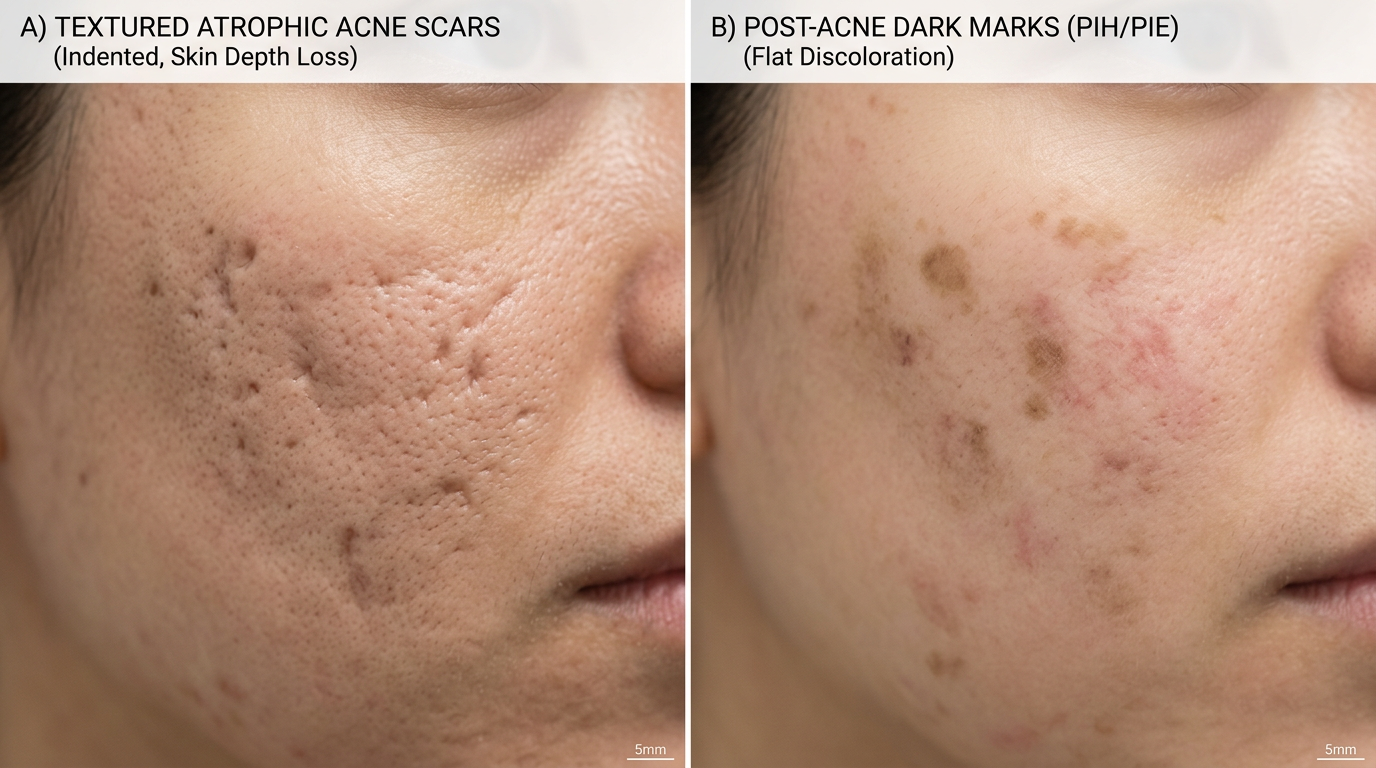
Acne scars are permanent textural changes in the skin caused by collagen damage during the healing process. Dark marks (post-inflammatory hyperpigmentation) are flat, discolored spots left behind after a breakout. Scars change your skin’s surface; dark marks only change its color. Scars typically need professional treatment, while dark marks often fade on their own over time.
The confusion between acne marks vs scars is honestly one of the biggest problems I see. People spend hundreds of dollars on scar treatments when they actually have acne hyperpigmentation — or vice versa. If you’re new to understanding your skin, my start-here guide walks you through the basics before you spend a dime on the wrong things.
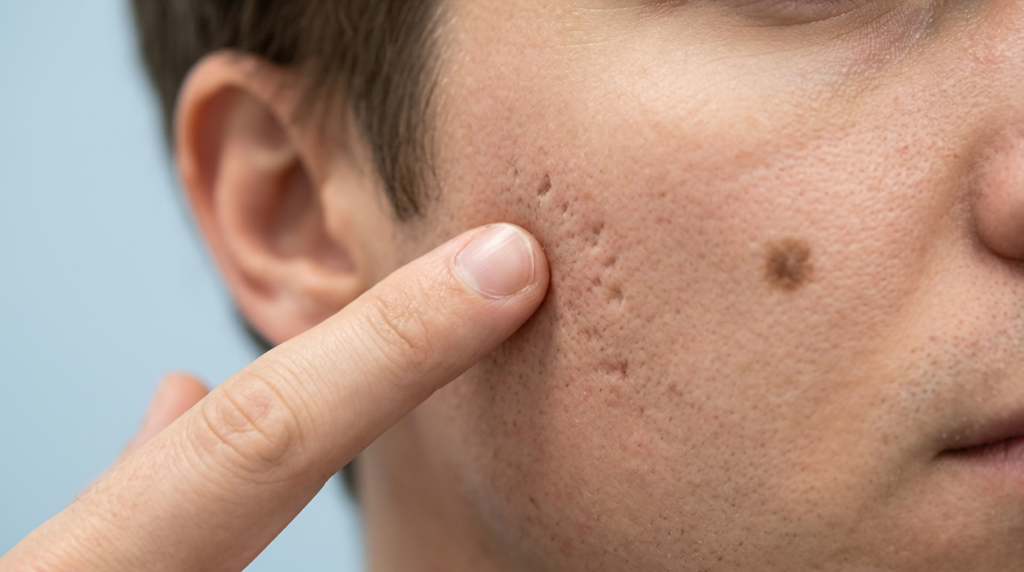
Here’s the simplest test I use: run your finger across the spot. If you feel a dip, a bump, or any textural irregularity, that’s a scar. If the skin is perfectly smooth but you see a pink, red, brown, or purple spot? That’s a dark mark. That’s it. That’s the whole test.
Why Your Skin Creates Scars vs Dark Marks (The Science)
When acne penetrates deep into the dermis, your body scrambles to repair the damage. Think of it like a construction crew working in crisis mode — sometimes they rebuild perfectly, and sometimes they cut corners.
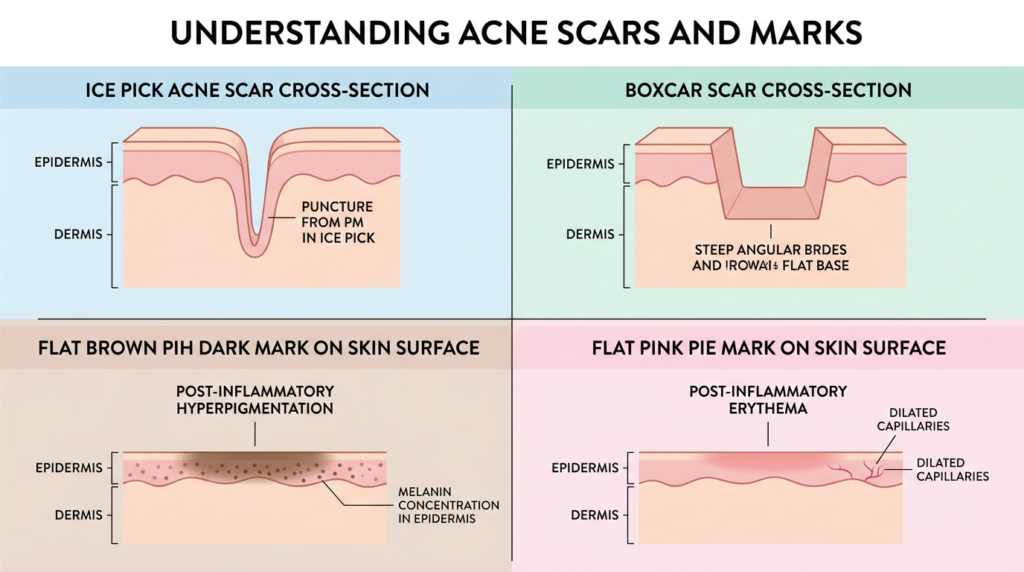
Dark marks (post-inflammatory hyperpigmentation or PIH) happen when inflammation triggers excess melanin production. Your skin essentially “stains” itself as part of the healing response. According to the American Academy of Dermatology, PIH affects all skin tones but appears more prominently in darker complexions. The good news? These post-acne marks are superficial and temporary — though “temporary” can mean anywhere from 3 months to 2 years without treatment.
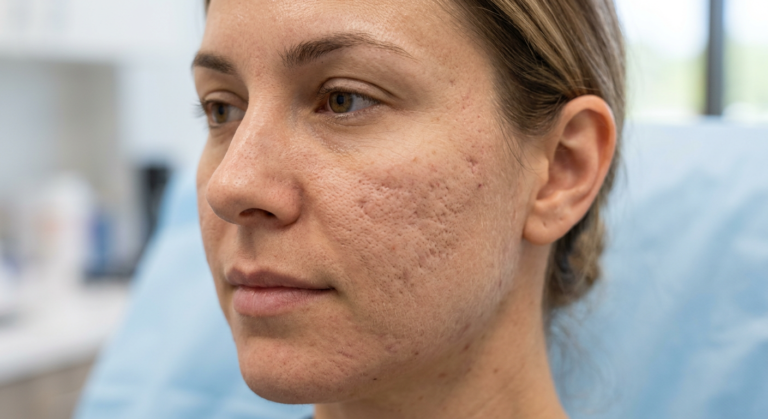
Acne scars form when the dermis itself sustains damage. Your body either produces too little collagen (creating atrophic or depressed scars like ice pick, boxcar, or rolling scars) or too much collagen (creating raised hypertrophic or keloid scars). Research published in the Journal of Clinical and Aesthetic Dermatology confirms that severe inflammatory acne — especially cystic and nodular types — carries the highest scarring risk.
The key takeaway? Inflammation is the enemy in both cases. The worse the inflammation, the worse the aftermath. If you’re still battling active breakouts, addressing those first matters more than anything — check out our acne types guide to understand what you’re fighting.
How to Identify Exactly What You Have
Let me give you a practical framework I use every single day:
Signs You Have Dark Marks (PIH/PIE)
- Flat spots with absolutely no texture change
- Pink or red marks (post-inflammatory erythema, more common in lighter skin)
- Brown or dark brown spots (classic PIH, more common in deeper skin tones)
- They lighten slightly over weeks or months
- They respond to the “press test” — press a clear glass against the spot and if it temporarily disappears, you likely have PIE (vascular-based)
Signs You Have Acne Scars
- Visible indentations or raised areas you can feel
- Texture doesn’t change over time without intervention
- Ice pick scars — narrow, deep holes
- Boxcar scars — broad, rectangular depressions
- Rolling scars — wave-like undulations under the skin
- Keloid/hypertrophic scars — raised, firm tissue
Many people have BOTH — and that’s completely normal. Our detailed page on acne scars breaks down each type with visual references so you can match what you see in the mirror.
How to Fade Dark Marks After Acne
Here’s where I get fired up, because the solution for post-acne marks is actually straightforward — but the skincare industry overcomplicates it to sell you stuff. IMO, you need three things:
1. Sunscreen (Non-Negotiable)
UV exposure darkens hyperpigmentation. Every single day. No exceptions. The National Institutes of Health has published extensive research showing UV radiation directly stimulates melanocyte activity. Skip sunscreen and nothing else you do matters.
2. Targeted Active Ingredients
These are the heavy hitters backed by clinical evidence:
- Vitamin C (L-ascorbic acid) — inhibits tyrosinase and brightens
- Niacinamide (Vitamin B3) — reduces melanin transfer between cells
- Alpha arbutin — gentler alternative to hydroquinone
- Azelaic acid — anti-inflammatory plus brightening
- Retinoids — accelerate cell turnover dramatically
- AHAs (glycolic acid, lactic acid) — remove pigmented surface cells
3. Patience and Consistency
Dark marks after acne fade. They just take time — typically 3 to 6 months with consistent treatment. I know that’s not what you want to hear, but it’s the truth. For a deeper protocol, visit our dark marks after acne resource page.
How to Get Rid of Acne Scars (The Honest Version)
This is where things get more complex — and more expensive, tbh. Unlike dark marks, true acne scars involve structural skin damage. You can’t just “serum” your way out of a collagen deficit.
At-Home Options (Mild Scarring Only)
- Retinoids (tretinoin or adapalene) — stimulate collagen remodeling over months of consistent use
- Silicone-based scar sheets — evidence-backed for raised scars specifically
- At-home microneedling — proceed with EXTREME caution because improper technique causes more damage than it fixes
Professional Treatments (Moderate to Severe Scarring)
- Professional microneedling — typically 3 to 6 sessions needed
- TCA CROSS — a targeted chemical peel technique that’s a game-changer for ice pick scars
- Laser resurfacing — fractional CO2 or erbium lasers
- Subcision — releases tethered scar tissue and works brilliantly for rolling scars
- Dermal fillers — temporary but provides immediate visual improvement
- Radiofrequency microneedling — combines needling with heat energy for enhanced collagen stimulation
The Mayo Clinic confirms that combination approaches typically yield the best outcomes for acne scar treatment. No single treatment fixes everything. Browse our full acne treatments guide for a breakdown of professional and at-home options.
Expert Commentary: This dermatologist-led breakdown offers an excellent visual walkthrough of how acne scars and post-inflammatory hyperpigmentation differ at the skin level — worth watching if you’re a visual learner trying to classify your own marks.
The Myths That Are Keeping You Stuck
Let me bust a few that drive me absolutely crazy:
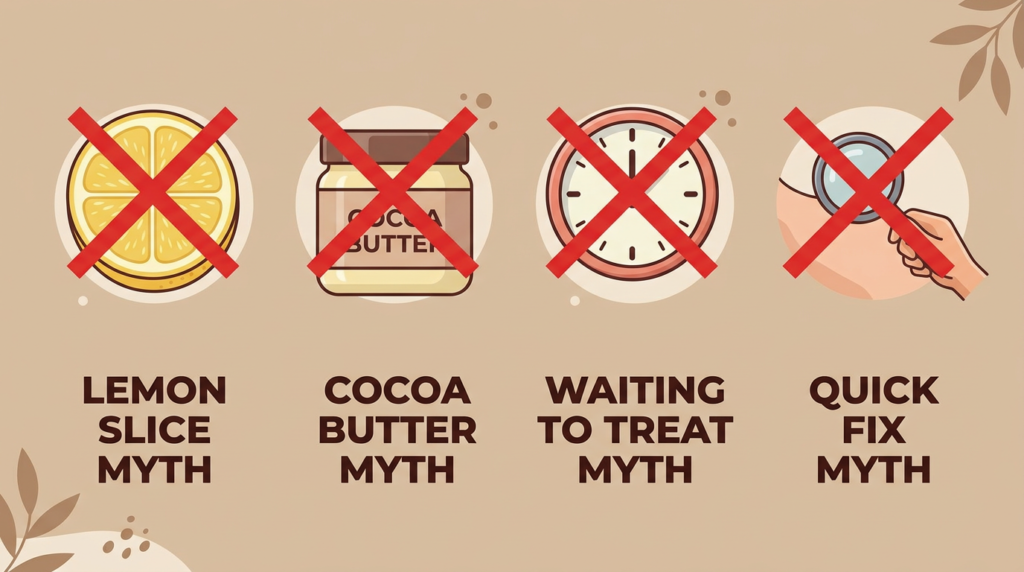
Myth: “Cocoa butter or bio-oil fades acne scars.”
Nope. These products moisturize, which can improve skin appearance temporarily, but they don’t restructure collagen or reduce melanin production. Full stop.
Myth: “Lemon juice is a natural brightener.”
Please don’t. Lemon juice has an extremely low pH that can cause chemical burns and — wait for it — make your acne hyperpigmentation WORSE through phytophotodermatitis. 🙃
Myth: “If I can see it, it’s a scar.”
Most of what people call “acne scars” are actually dark marks. True scarring involves texture changes, not just color. This distinction matters because it completely changes your treatment strategy.
Myth: “Scars will fade on their own eventually.”
Dark marks will fade (usually). Scars won’t. Atrophic acne scars are permanent without professional intervention. Wishing them away doesn’t count as a treatment plan.
When to See a Dermatologist
I’m a huge advocate for informed self-care, but here’s when you need professional help — no question:
- Deep ice pick or boxcar scars that haven’t responded to retinoids
- Keloid scarring, especially if it’s actively growing
- Dark marks that haven’t faded after 12+ months of consistent treatment
- You genuinely can’t tell whether you have scars or marks (no shame in that)
- Active cystic acne that’s likely to cause more scarring
A board-certified dermatologist can perform treatments that no over-the-counter product can replicate. The AAD’s dermatologist finder is a solid resource for locating one near you. And for a broader look at skin issues beyond scars and marks, explore our skin concerns hub. 🙂
Frequently Asked Questions
Are dark marks from acne permanent?
No. Dark marks (post-inflammatory hyperpigmentation) are temporary and typically fade within 3 to 12 months. Consistent use of sunscreen, vitamin C, and retinoids can significantly accelerate the fading process.
Can acne scars be completely removed?
Most acne scars can be significantly improved — 50 to 80 percent improvement is a realistic expectation — but complete removal is rare. Combination treatments like microneedling, laser resurfacing, and subcision offer the best results.
What’s the fastest way to fade dark marks after acne?
The fastest approach combines daily broad-spectrum sunscreen (SPF 30+), a vitamin C serum in the morning, and a retinoid at night. Professional chemical peels can accelerate results even further when layered on top of a solid home routine.
Do acne scars get worse with age?
Yes. As your skin loses collagen naturally with aging, atrophic (depressed) acne scars can become more noticeable over time. That’s why early treatment gives you a real advantage.
Is post-inflammatory erythema (PIE) the same as hyperpigmentation (PIH)?
No. PIE presents as pink or red marks caused by damaged blood vessels and shows up more commonly in lighter skin. PIH presents as brown or dark spots caused by excess melanin and appears more commonly in darker skin. Both fall under post-acne marks but they respond to different treatments.
My Top Recommended Gear
After years of testing and recommending products, these three consistently deliver results for people dealing with acne scars and dark marks after acne:
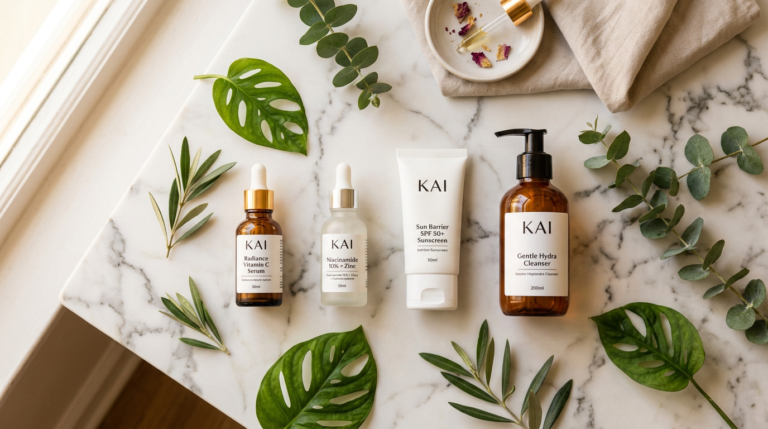
- Paula’s Choice 2% BHA Liquid Exfoliant — My go-to recommendation for keeping pores clear and preventing new marks. The salicylic acid also helps improve skin texture over time.
- La Roche-Posay 10% Pure Vitamin C Serum — A stable, effective vitamin C formula that I’ve watched fade acne hyperpigmentation noticeably faster when used consistently every morning.
- EltaMD UV Clear Broad-Spectrum SPF 46 — The single best sunscreen for acne-prone skin. Contains niacinamide, won’t break you out, and protects healing marks from UV darkening. Non-negotiable in any how to fade dark marks routine.
Disclaimer: This post contains affiliate links. As an Amazon Associate, I may earn a commission from qualifying purchases at no additional cost to you.