Benzoyl Peroxide: The Acne-Fighting Workhorse That Actually Works (And How Not to Destroy Your Face Using It)
You’ve probably heard the name. Maybe a dermatologist dropped it casually during a three-minute consultation that cost you $200. Perhaps your older sister swore by it in high school, or you spotted it on the shelf at CVS sandwiched between seventeen other acne products making impossible promises.
Benzoyl peroxide doesn’t make impossible promises. It just works—aggressively, reliably, and sometimes with the subtlety of a sledgehammer. It’s been clearing acne since the 1930s, which in skincare years makes it practically ancient. But unlike most vintage beauty treatments (looking at you, radioactive face cream), benzoyl peroxide earned its staying power through actual science, not marketing wizardry.
Here’s what you actually need to know about this pharmaceutical powerhouse: how it works, why dermatologists consider it a first-line acne treatment, what strength you should use, and most importantly, how to avoid turning your face into a peeling, red disaster zone.
Table of Contents
What Benzoyl Peroxide Actually Does to Your Skin
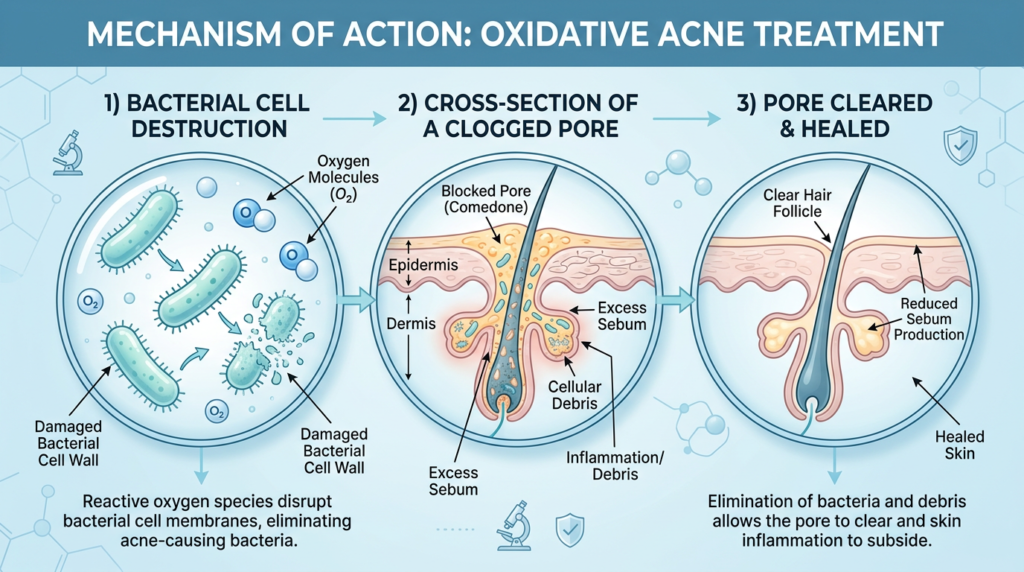
Benzoyl peroxide attacks acne through three distinct mechanisms, and understanding them helps you use it smarter.
First, it kills Cutibacterium acnes (formerly Propionibacterium acnes)—the bacteria that throws house parties in your clogged pores and triggers inflammatory acne. Unlike antibiotics, which bacteria can develop resistance to over time, benzoyl peroxide works through oxidation. It essentially explodes bacterial cell walls with oxygen free radicals. Bacteria can’t evolve their way out of that party trick.
Second, it breaks down the comedonal plugs clogging your pores. Those blackheads and whiteheads? Benzoyl peroxide helps dissolve the cellular debris and excess sebum creating the traffic jam. According to research published in the Journal of Clinical and Aesthetic Dermatology, this keratolytic action makes it effective against both inflammatory and non-inflammatory acne lesions.
Third, it has mild anti-inflammatory properties. While not its primary superpower, this effect helps calm the angry redness around active breakouts.
The American Academy of Dermatology consistently recommends benzoyl peroxide as a foundational acne treatment, often as the first thing to try before escalating to prescription medications. That institutional endorsement isn’t handed out lightly.
Concentration Matters More Than You Think
Benzoyl peroxide comes in concentrations ranging from 2.5% to 10%, and here’s where most people screw up: they assume higher percentages work better. They don’t—at least not enough to justify the increased irritation.
A landmark study in the Journal of the American Academy of Dermatology compared 2.5%, 5%, and 10% benzoyl peroxide formulations. The 2.5% concentration proved just as effective at reducing acne lesions as the 10% version, but caused significantly less dryness, peeling, and redness. The higher concentrations irritated skin more without delivering proportionally better results.
Start with 2.5% or 5% maximum. Your skin will thank you, and you won’t spend three weeks looking like you got a chemical peel in a back alley. If you’re dealing with stubborn acne and the lower concentration isn’t cutting it after 8-12 weeks, then consider moving up. But don’t lead with the nuclear option.
The vehicle matters too. Gels penetrate more aggressively and work better for oilier skin types. Creams and lotions deliver gentler, more moisturizing formulations suited for sensitive or dry skin. Foaming washes work well for body acne but spend less contact time on skin, making them less potent than leave-on treatments.
How to Use It Without Destroying Your Moisture Barrier
The most common benzoyl peroxide mistake? Going full throttle from day one. Your enthusiasm will be rewarded with a face that feels like the Sahara and looks like a tomato.
Here’s the smart approach:
Week 1: Apply a thin layer to affected areas once daily, preferably at night. Not your entire face unless your entire face has active acne. Target the problem zones.
Week 2-3: If your skin tolerates it well—no significant dryness, stinging, or peeling—increase to twice daily application.
Ongoing: Use consistently. Benzoyl peroxide doesn’t fix acne overnight. You’ll typically see improvement within 4-6 weeks, with maximum results around 12 weeks, according to data from the National Institutes of Health.
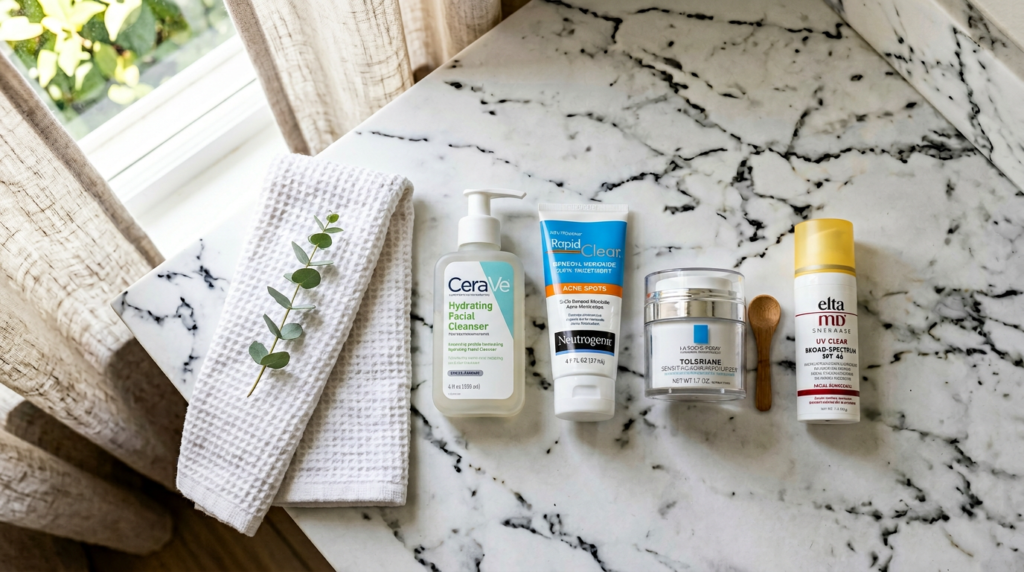
Pair it with a solid moisturizer. This isn’t optional—it’s essential. Benzoyl peroxide works by causing controlled irritation and drying. If you don’t compensate with hydration, you’ll trigger your skin to overproduce oil as a defense mechanism, potentially making acne worse. The irony is not lost on anyone.
Apply benzoyl peroxide to completely dry skin. Damp skin increases penetration, which sounds good but actually increases irritation beyond the therapeutic sweet spot. Wait 5-10 minutes after washing your face before applying.
The Bleaching Problem Nobody Warns You About
Benzoyl peroxide will absolutely destroy your nice towels, pillowcases, and shirts. It’s not a maybe—it’s a guarantee.
The same oxidizing action that murders acne bacteria also bleaches fabric dyes on contact. You’ll notice mysterious orange-white splotches on anything that touches your treated skin while the product is still active.
The solution? Dedicate white towels and white pillowcases to your benzoyl peroxide routine. Sleep in old t-shirts you don’t care about if you apply it at night. Or switch to morning application and give it 10-15 minutes to fully absorb before dressing. Some dermatologists recommend applying benzoyl peroxide in the morning specifically to avoid the linen massacre.
Consider this your official warning. Don’t say the internet didn’t tell you.
Combining Benzoyl Peroxide with Other Actives (Carefully)
Benzoyl peroxide plays nicely with some ingredients and turns into a skin irritant tornado with others.
Safe combinations:
- Niacinamide: This vitamin B3 derivative actually helps reduce the irritation benzoyl peroxide causes while adding its own anti-inflammatory benefits.
- Hyaluronic acid: Pure hydration with no interaction concerns.
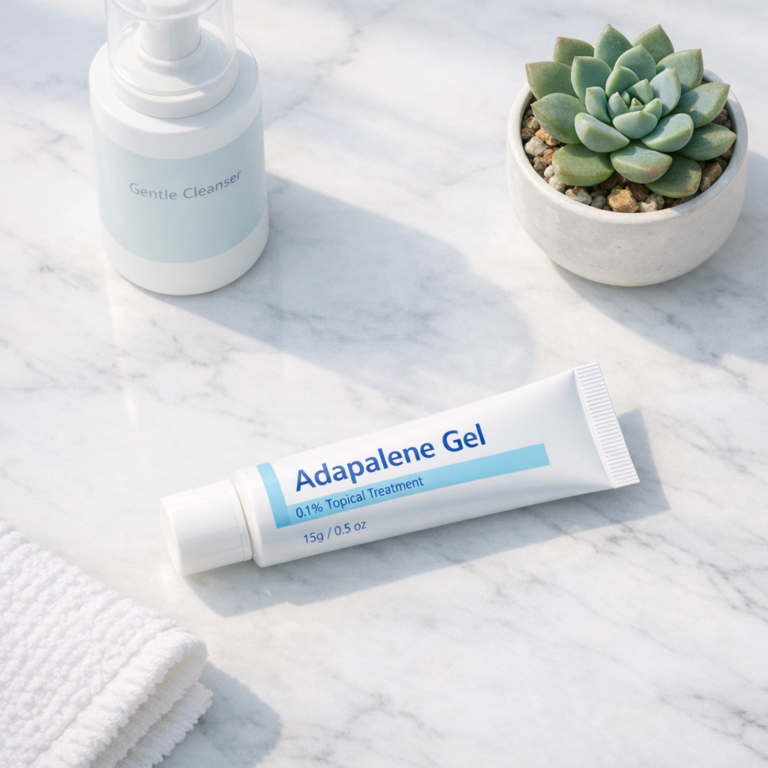
- Adapalene: Many dermatologists recommend this retinoid-benzoyl peroxide duo for moderate acne. Products like Epiduo combine both in one formulation.
Risky combinations:
- Vitamin C (L-ascorbic acid): Benzoyl peroxide can oxidize and destabilize vitamin C, rendering both less effective. Use vitamin C in your morning routine and benzoyl peroxide at night, or alternate days.
- Retinol/Tretinoin: Combining these with benzoyl peroxide can work under dermatologist supervision, but doing it yourself often leads to severe irritation. If you go this route, apply them at different times of day.
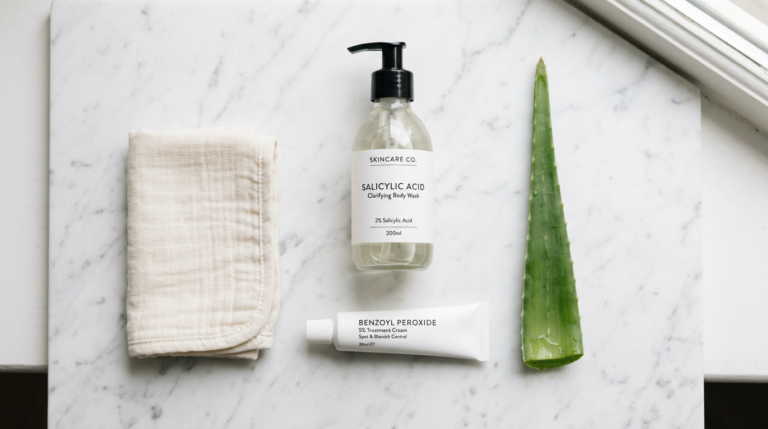
- AHAs/BHAs: Layering glycolic acid or salicylic acid with benzoyl peroxide is asking for chemical burns. Pick one exfoliating treatment or alternate days.
If you’re a visual learner (or just want to see a dermatologist explain this stuff with more authority than a blog post can muster), this video breaks down benzoyl peroxide use with clinical precision:
Who Shouldn’t Use Benzoyl Peroxide
Despite its generally solid safety profile, benzoyl peroxide isn’t universal.
Skip it if you have:
- Eczema or rosacea: The irritation will likely trigger flares rather than help anything
- Very sensitive skin conditions: Seborrheic dermatitis and perioral dermatitis typically worsen with benzoyl peroxide
- Known allergy to benzoyl peroxide: Obvious, but worth stating
Topical benzoyl peroxide is generally considered low-risk in pregnancy and breastfeeding because systemic absorption is minimal, and it’s often listed as an acceptable option compared to oral acne medications. That said, the FDA retired its old A/B/C/D/X pregnancy risk categories in 2015, so you may still see “Category C” mentioned elsewhere online — it’s outdated shorthand, not current guidance. Talk to your OB-GYN or dermatologist before starting or continuing any acne treatment during pregnancy rather than relying solely on internet advice.
The Mayo Clinic notes that some people experience contact dermatitis from benzoyl peroxide. If you develop severe redness, swelling, or itching beyond normal initial adjustment, discontinue use and talk to a dermatologist.
Body Acne Gets the Same Treatment
Everything discussed applies equally to back acne, chest acne, and shoulder breakouts. Actually, body acne sometimes responds even better to benzoyl peroxide because the skin is thicker and less sensitive than facial skin.
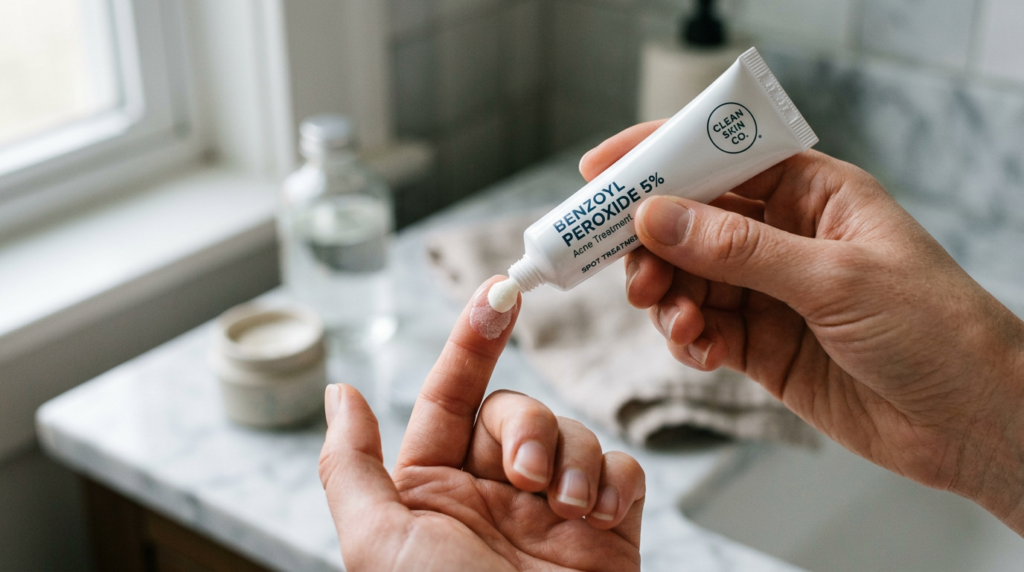
Benzoyl peroxide body washes work particularly well here—they’re easier to apply over large areas than leave-on creams. Brands like PanOxyl and Neutrogena make 10% body washes that you can leave on skin for 1-2 minutes before rinsing. The higher concentration is more tolerable on body skin, and the wash-off format prevents the total destruction of your wardrobe.
For stubborn back acne, consider using a leave-on benzoyl peroxide lotion after showering, then wearing a white t-shirt until it absorbs. Your back will clear up, and you’ll preserve your good clothes.
The Sunscreen Non-Negotiable
Benzoyl peroxide doesn’t technically increase photosensitivity the way retinoids or AHAs do, but it can make your skin more vulnerable to irritation from sun exposure, especially during the initial adjustment period when your moisture barrier is compromised.
Translation: wear sunscreen daily. This isn’t skincare maximalism—it’s basic protection. The Skin Cancer Foundation emphasizes that any acne treatment routine should include broad-spectrum SPF 30 or higher.
Acne-prone skin does better with mineral sunscreens (zinc oxide or titanium dioxide) or oil-free chemical sunscreens specifically formulated for breakout-prone complexions. Skip heavy, greasy formulations that will clog the pores you’re working so hard to clear.
What Success Actually Looks Like
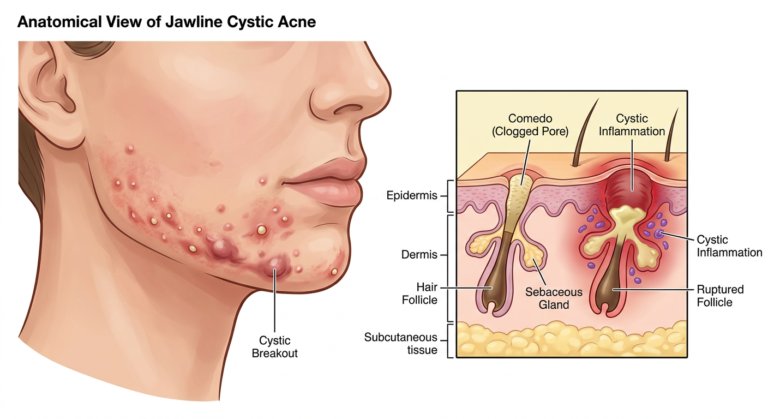
Set realistic expectations. Benzoyl peroxide excels at treating inflammatory acne—those red, angry pustules and papules. It helps with blackheads and whiteheads moderately well. It does absolutely nothing for cystic acne, which lives too deep in the skin for topical treatments to reach effectively.
If you have severe or cystic acne, benzoyl peroxide might help as part of a larger treatment plan, but you’ll likely need prescription interventions like oral antibiotics, hormonal treatments, or isotretinoin. Don’t waste months trying to fix deep cystic acne with over-the-counter products alone—see a dermatologist.
For mild to moderate acne, benzoyl peroxide can be genuinely transformative. You should notice fewer new breakouts within 2-3 weeks and significant improvement in overall skin clarity by the 6-8 week mark. Active lesions should heal faster, and you should see fewer new ones forming.
The Bottom Line: Boring, Effective, and Cheap
Benzoyl peroxide won’t make a good Instagram post. It doesn’t come in aesthetically pleasing minimalist packaging designed to look good on your bathroom shelf. It’s not trendy, and skincare influencers don’t get particularly excited about it because it’s been around forever and costs about $8.
But it works. Consistently, reliably, predictably.
It’s one of the few acne treatments with decades of solid research, dermatologist consensus, and real-world results backing it up. The science isn’t controversial or emerging—it’s established.
Start with a low concentration, use it consistently, pair it with good moisturizer and sunscreen, protect your nice towels, and give it three months. If you’re still breaking out significantly after that period, escalate to a dermatologist for prescription options. But for a huge percentage of people dealing with common acne, this unglamorous tube of medication might be exactly what finally works.
Ready to give benzoyl peroxide a proper shot? Start with a 2.5% formulation, commit to the routine for at least 8 weeks, and document your progress with weekly photos. Your skin won’t thank you—skin doesn’t talk—but your mirror will show the results. And if you’ve found a specific product or technique that works particularly well with benzoyl peroxide, drop it in the comments. Real-world experience beats theoretical advice every time.